Why Most AI Implementations Fail
Most companies that invest in AI do not get what they paid for. The failure is rarely the technology. The models work. The platforms function. The capabilities are real. The failure is where and how the technology gets applied.
AI on a broken process just automates the problem. A sales team with an undisciplined follow-up process doesn't need an AI sequence engine — it needs a redesigned follow-up process, and then an AI sequence engine.
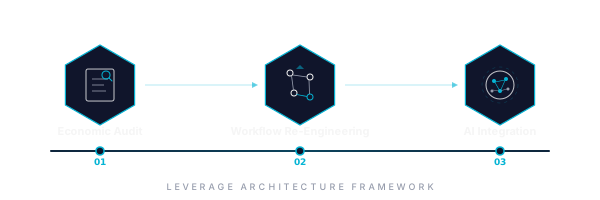
Step 1: Economic Audit
Every engagement begins with a question: where is the money going, and what is it producing?
The Economic Audit is a comprehensive assessment of how a client's organization actually operates — not how the org chart describes it, but how time, money, and effort are actually spent.
- Time allocation by role and function — where do people spend their hours? How much is revenue-generating versus administrative?
- Process efficiency — how many steps does each core workflow require? Which add value?
- Technology utilization — what tools are used, and how much of each tool's capability is actually leveraged?
- Cost-to-output ratios — what does each unit of output actually cost in labor, technology, and overhead?
- Knowledge dependencies — where is critical process knowledge held by individuals rather than systems?
The audit produces a detailed economic map: a prioritized list of inefficiencies, each quantified by annual cost impact. No guessing. No assumptions. Data first.
Step 2: Workflow Re-Engineering
The Economic Audit identifies the problems. Workflow Re-Engineering fixes the architecture before AI enters the picture.
Why before AI: Automation applied to a bad process produces bad results faster. An AI lead scoring model built on dirty CRM data scores leads inaccurately — at scale. A knowledge base built on undocumented processes captures and distributes confusion.
What it looks like:
- Redundant steps removed — approval chains streamlined, upstream errors fixed instead of compensated for
- Handoffs redesigned — delays at handoff points are the most common source of operational drag
- Data models unified — fragmented data consolidated into a single source of truth
- Processes documented — every re-engineered workflow documented for both human execution and AI automation
Step 3: AI Leverage Integration
With clean workflows in place, the technology enters — and it enters with precision.
We are platform-agnostic. Our loyalty is to your margin, not a software vendor. HubSpot, Salesforce, Outreach, Marketo, Zapier, custom integrations — whatever serves the workflow best. The technology is selected to maximize the return identified in the Economic Audit.
Every deployment is measured against the baseline established in the Economic Audit. The question is never "is the AI working?" — it is "is the AI producing the economic return we projected?"